

Writing about climate change, with a lump in my throat

A centuries‑old olive tree burns from the inside out, which is why firefighters find it so difficult to bring fires in olive groves under control. Photo Milos Bicanski / Climate Visuals Countdown
For some 25 years, I wrote about climate change for NRC. In this farewell essay, I look back on this peculiar kind of journalism. Peculiar because the most important stories are often not about what has happened, but about what lies ahead for the world. Peculiar, too, because the news unfolds at such a painfully slow pace.
How has the world dealt with this threat over the past quarter century? What choices have I made as a journalist? “I have seen journalism change faster than the climate itself.”
Saturday, December 12, 2015, 7:00 p.m. What on earth is going on? Why is it taking so long? In the cavernous press center housing the more than three thousand journalists accredited for COP21 – the climate summit in Paris – no one knows for sure. We are all scrambling for scraps of information, sharing what we hear from our sources, of whom it is rarely entirely clear just how close to the action they actually are. Apparently, there is an issue with the final text of the climate agreement, a document that has been the subject of intense negotiation over the past two weeks – and, in fact, throughout the entire year.
Earlier that morning, following endless overnight deliberations, COP president Laurent Fabius had hailed the agreement as balanced, ambitious, and fair. Speaking in a tone more emotional than he usually did, he described it as “an agreement we never thought we would reach.” Yet, just before he could bring down the gavel, confusion erupted on the stage and negotiators once again retreated behind closed doors. Oddly enough, French colleagues said that president François Hollande was already on his way from the Élysée Palace, the presidential residence in the heart of Paris. Surely, the end couldn't be far off.
Hours drag by. Delegates chat while others stare resignedly at their laptops or phones. Some have dozed off with their heads on the tables after a sleepless night. Most of the restaurants are closed. The immense conference complex, thrown up specifically for the occasion at the former Le Bourget airport, is being dismantled, as if they were merely stage sets from a play that has already ended.
Then, shortly before 7:30 p.m., the buzz in the room intensifies, and Fabius asks everyone to take their seats. The climax lasts barely a minute. “I see the room,” says Fabius. “I see the reaction is positive; I hear no objection. The Paris Climate Agreement is adopted.” A deafening cheer erupts in the hall; people embrace one another, many with tears in their eyes. At last, the world is to be freed from the dangers of climate change.
There is applause even in the press room, though certainly not from everyone. I hesitate, but decide not to join in. I have been writing about climate change for fifteen years, always guarding against the loss of my journalistic detachment. Never has that been more difficult than it is now. With a lump in my throat, I feel I am witnessing a momentous historical event. I have spent years writing towards this very moment.
And now, almost eleven years after summit in Paris, I am bidding farewell to this extraordinary branch of journalism. Extraordinary, because the most important stories are often not about what has happened, but about what awaits the world – a ‘preview’ of which we experienced again this summer. Extraordinary, too, because the ‘new’ in the news reporting unfolds so agonizingly slowly that it barely gets noticed.
I have seen the profession change faster than the climate itself. When I wrote my first stories on climate change twenty-five years ago, I was the only one at NRC doing so – alongside a single science editor. Today, at least seven editors work on the subject full-time, and sports and culture journalists regularly write about the climate as well. Fashion, terrorism, football, migration – there is hardly a topic imaginable that doesn't intersect with climate change.
I will never be an activist, but for once, I am going to set aside the detachment that NRC – rightly – expects of its editors. Or at least, I intend to; for it is not easy to give the journalistic craft such a different direction. What choices have I made over the past twenty-five years? What emotions have I stirred in readers? Where did my doubts lie? How did I cope with my frustrations over yet another failed climate summit, with the fear that we are not doing nearly enough to confront this immense challenge and keep the planet livable for generations to come, and with the hope that perhaps we still might?
Optimistic. Perhaps too much so?
The analysis I wrote after that emotional moment in Paris went online an hour later and appeared on the newspaper’s front page that Monday. “After two weeks of negotiations, the world reached a climate agreement on Saturday that heralds the end of an economy based on fossil fuels,” I wrote. “The Paris Agreement enshrines an awareness long held by many: that the world must stop using coal, oil, and gas to avert dangerous global warming.”
The tone is optimistic; the rhetoric grand. Are the words too grand, in hindsight? With what I know now, was I too optimistic? Perhaps, but I am in good company. “A fantastic day for humanity,” wrote the Süddeutsche Zeitung. “The greatest diplomatic success ever,” according to The Guardian. US Secretary of State John Kerry spoke of “a victory for the entire planet and for future generations.” According to Indian Environment Minister Prakash Javadekar, “a new chapter of hope” was opened in Paris.
In all these reactions you can sense a certain relief that success was finally achieved. For the first time, the entire world seemed to acknowledge that climate change might well be the greatest crisis humanity has ever faced – a crisis that can only be tackled through an unprecedented, collective effort.
The planet’s limits have been reached, French philosopher Bruno Latour wrote in 2017 in his brilliant essay Où atterrir?. If the Paris Agreement is implemented as intended, all those fine development plans based on excess can go straight into the trash, Latour argued. After all, realizing them all would require several planets. And we have only one.

Schoolchildren wade through floodwaters in Sivasagar, Assam, India. Photo Ritesh Shukla/Getty Images
For centuries, the Earth has been used as a seemingly inexhaustible warehouse of raw materials and a bottomless pit for waste. Since the Industrial Revolution, this has led to climate disruption that can no longer be resolved simply through a bit of extra technology and smart policy. The Paris Agreement, if implemented as intended, puts an end to…
Yes, to what, exactly? To the endless growth of economies? To the unequal distribution of wealth? To the promise that everyone on Earth can live like a wealthy Westerner? No politician dares say it out loud – and if asked, they might well deny it – but the negotiations in Paris were about global scarcity and how to share it fairly.
“The American way of life is not up for negotiation. Period,” said US President George H.W. Bush upon arriving at the first major climate conference in Rio de Janeiro in 1992. Yet it is precisely that American way of life that has been under scrutiny at this conference – and at every conference since.
“If there is no planet, no Earth, no soil, no territory” where everyone can share in the wealth, writes Latour in his essay, “then there is no longer a settled ‘home’ for anyone.” The choice is ours: “Do we keep dreaming of escape, or do we take action to find a territory that we and our children can inhabit?”
Since that drizzly, unseasonably warm December day in 2015, this has been the dilemma every government, in every country, has had to grapple with, and the answer has had to be fought for time and again. Because reluctant and fearful politicians, hesitant companies, and doubtful citizens would rather not hear it.
‘Doubt is our product’
Uncertainty regarding the risks of climate change only makes the dilemma harder to resolve. The subject has become so politicized and polarized that one side attempts to exaggerate the uncertainty, while the other downplays existing uncertainties. As a climate journalist, you can’t really win. I have frequently been accused of exaggeration and criticized for failing to provide a platform for ‘opposing views’. Yet I am also accused of not shaming the ‘climate polluters’ hard enough, even though many insist the time for nuance is long gone.
The foundation of that science has actually been crystal clear for 130 years. In 1896, the Swedish physicist and chemist Svante Arrhenius described the principle of the enhanced greenhouse effect. Based on his knowledge of how carbon dioxide (CO2) absorbs infrared radiation, he calculated what would happen to the Earth’s temperature if the concentration of this gas in the atmosphere were to change. He published his findings in the Philosophical Magazine. His conclusion is clear: the atmosphere acts as the planet’s active thermostat. The more greenhouse gases there are, the warmer it gets.
Why, then, does denial keep rearing its head? Could it be that doubt serves as a last straw? If it might not be ‘true’, then perhaps the consequences won’t be so bad after all. Or does this emphasis on uncertainty stem from oil companies that have fueled doubt for years?
Shell, Exxon, and all the other fossil fuel companies realized very early on what their product was doing to the Earth. For instance, at the American Petroleum Institute’s centennial celebration in 1959, Edward Teller, the ‘father of the hydrogen bomb’, warned that burning coal, oil, and gas “causes a greenhouse effect in the atmosphere.” According to Teller, if the demand for these fossil fuels grew, the Earth’s average temperature would rise enough to “melt ice caps and submerge New York.”
We are conducting a vast geophysical experiment with the planet
Three years later, Shell’s geological department predicted that the rapidly increasing use of fossil fuels could lead to “serious contamination of the atmosphere.” The renowned Stanford Research Institute, conducting research commissioned by Big Oil in 1968, even described CO2-emissions as a “vast geophysical experiment” involving the planet. According to the Stanford scientists, there was only one solution to prevent damage: stop using gasoline.
That was not the message oil companies wanted to hear. In response, they adopted the strategy the tobacco industry was already successfully using to cast doubt on the harmful effects of smoking. In a confidential document from 1969, the American tobacco company Brown & Williamson wrote: “Doubt is our product, since it is the best means of competing with the ‘body of fact’ that exists in the minds of the general public. It is also the means of establishing a controversy...”
Oil companies began magnifying uncertainties regarding climate change, downplaying its consequences, and obscuring (their own) research findings. “It seems a reasonable conclusion,” the National Petroleum Council (NPC) wrote in 1972, “that it will be impossible to determine – at least until the end of the century – whether we are facing a serious problem.” The NPC anticipated that technology would be able to mitigate the risks by then. That is how things always have unfolded throughout history.
‘Pure fear-mongering,’ says a reader
While the fossil fuel industry now grudgingly acknowledges that the climate is changing, this has not put an end to the flood of fake news regarding the climate – complete with think tanks, quasi-scientific conferences, and bogus journals filled with charts that cherry-pick data. U.S. president Donald Trump is not the only one to dismiss climate change as “the greatest hoax ever,” as he did in his speech at the United Nations last year. Far-right think tanks and political parties, such as Forum for Democracy, the PVV and the BBB in the Netherlands, pretend that global warming is insignificant and that climate policy is a waste of money.
They do so using the same lines of reasoning I have encountered in hundreds of letters and emails sent to me by readers over the past 25 years. They frequently attempt to change my mind, often by employing arguments that have been debunked time and again. Yet, natural climate variability, fluctuations in solar activity, or unreliable weather stations cannot explain why the Earth has been warming so rapidly since the Industrial Revolution. The increase in atmospheric CO2 resulting from the burning of coal, oil, and gas, however, can.
In 2017, a reader offered a remarkable list of potential causes for climate change – anything seemed to be on the table, provided it isn’t greenhouse gases: “Shifting magnetic poles, changes in solar energy, the influence of the ninth planet, shifts in heat currents from the Earth’s core via tectonic plate movements…” Around the same time, another reader wrote: “The answer, of course, is that climate change is indeed happening, much as it has for millions of years, but there is nothing we can do about it, certainly not by limiting CO2.”
Many readers are indignant, believing that I am sometimes deliberately trying to ‘sow fear’
Often, readers argue that I am concealing the ‘real’ cause: “If humans are indeed responsible for global warming, it is solely due to the massive growth of the global population [in developing countries].” I reply that, naturally, global population growth does affect greenhouse gas emissions – a point the Club of Rome made as early as the 1970s. But this is a diversionary tactic, pinning the blame on poor nations for a problem to which they have barely contributed. The wealthiest 10 percent of the global population, a group that includes virtually everyone in the Netherlands, is responsible for half of all greenhouse gas emissions.
Many readers are indignant because, in their view, I sometimes deliberately try to “sow fear”. For instance, one person wrote: “I find it truly disgraceful that so many people have gradually been made terrified of the consequences of CO2 emissions, genuinely believing that humans are the primary cause of climate change and that the world is heading toward dire times.” Others asserted, with an almost religious certainty, that humanity cannot possibly be responsible for global warming: “What an inflated sense of self-importance, to imagine that humans have a major influence on the climate.” In short: “This is pure fear-mongering. The climate situation isn't urgent at all. More and more people are realizing this; everyone, that is, except editor Luttikhuis.”
Nowadays, reactions tend to focus on policy, a subject on which people can certainly hold differing opinions. Critics on the right view climate policy as “too expensive and patronizing.” They describe it as a lobby driven by left-wing politicians, aided by a left-leaning media (including NRC), aiming to bring about a socialist utopia. My perspective on the climate has nothing to do with political leanings. I am convinced that the price of failing to implement policy will be high. Far higher than the costs of mitigating climate change.
Waiting is dangerous
The problem is not a lack of knowledge; the greatest uncertainty in climate science is human behavior. The extent of global warming depends on our willingness to reduce greenhouse gas emissions. In the autumn of 2017, at the sustainability festival ‘Springtij’ (Spring Tide) on the island of Terschelling, I ran into Leo Meyer, an expert in international climate policy. We walked together past an exhibition showcasing ‘innovators and frontrunners.’
Standing before a panel detailing the consequences of climate change, he remarked: “I wish I could return to Earth a hundred years from now, just to see confirmation of everything that is currently still shrouded in uncertainty.” I recognize that sentiment. It is not a matter of doubt, but rather a question of whether we will do enough this century to turn the tide.
In 2015, I wrote an article on this subject titled ‘Our Apocalypse in Slow Motion’. It begins as follows: “Global warming is fraught with so many uncertainties that sitting back and waiting becomes tempting – even though that is simply not an option. As a climate journalist, it can be disheartening.” To steady my nerves, I turned to climate experts working at the intersection of science and policy.
Take, for instance, earth scientist Klaas van Egmond, who in 2004 founded the Netherlands Environmental Assessment Agency (PBL). “We’re perfectly willing to pour billions into the economy every month to drag ourselves out of the [euro] crisis,” says Van Egmond. “Yet we’ve been talking about the climate for decades, with very little actually happening. Even though climate science is arguably the best-organized scientific field in the world.” According to Van Egmond, all science operates under “a kind of law of the conservation of uncertainty,” but that should never be a reason to lapse into doubt.
Meteorologist and glaciologist Peter Kuipers Munneke, now a columnist for NRC, explains that the term “uncertainty” carries a very different meaning in everyday life than it does at a scientific symposium. While scientists might bicker endlessly over the precise extent to which global warming and sea-level rise are driven by rising CO₂ levels, Kuipers Munneke argues that politicians shouldn't follow suit. “My advice to policymakers would be: just accept it as a premise, because it’s the soundest foundation for making decisions. The risk of doing nothing when there is a real problem is far greater than the risk of taking action only to find the situation isn't as dire as feared.”
That may be true, but politicians are generally reluctant to invest billions in policies whose potential benefits will only become apparent in the long run. And it doesn’t get any easier when they have to do so on the basis of IPCC reports that are packed with caveats. The IPCC’s conclusions are rarely classified as “virtually certain”. Can a politician reasonably base policy on research where the probability of it being correct is, at best, “more likely than not”. That is, just slightly better than a coin toss?
It reminds me of what the Dutch prime minister Mark Rutte said at the start of the coronavirus crisis. He found it difficult to make 100 percent of the necessary decisions while only having 50 percent of the information. Yet, he did it anyway, because there was no other choice. He has never said anything similar regarding climate policy, even though the same principle has applied there for decades. Waiting for 100 percent certainty is too dangerous. By the time that is reached, there will be no turning back.
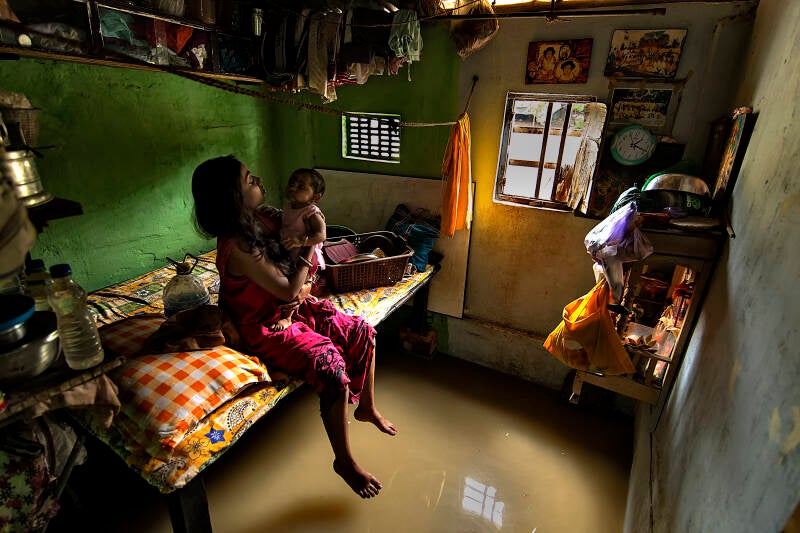
A mother and her baby sit on a bed in their small home, above a flooded floor. Photo Joydeep Mukherjee / Climate Visuals Countdown
I waver between pessimism and hope
In 2018, climate scientists are investigating whether the ultimate goal of the Paris Agreement—limiting temperature rise to 1.5 degrees – is still achievable. A massive, concerted effort is underway to complete a report in time for the climate summit in Katowice, Poland, later that year. This provided a perfect opportunity to team up with a colleague and interview the prominent Dutch climate scientist Heleen de Coninck, one of the report’s lead authors.
It is a warm, sunny day at the end of a summer nearly as dry as the one we have experienced this year. The water level in the branch of the Waal River near Nijmegen, where De Coninck’s houseboat is moored, is extremely low. Fortunately, her boat is more or less level – unlike that of her neighbors.
At a warming level of 1.5 degrees, the consequences for humanity remain, to some extent, manageable. Beyond that threshold, we risk losing control over the die-off of coral reefs, sea-level rise, the loss of biodiversity, and the potential collapse of the Gulf Stream. Heatwaves would become more extreme, droughts would last longer, floods would occur more frequently, wildfires would grow more dangerous, and hurricanes would become more devastating—a list I have written down in various forms many times before.
To prevent all of this, De Coninck’s report argues that the world must break its addiction to fossil fuels within thirty years, put an end to deforestation, and undergo a radical shift in dietary habits. Furthermore, people must consume fewer goods. That seems impossible to me. What does De Coninck think about this? “In this report, we outline a world that allows people to actually imagine that success ís possible”, she explains. “And perhaps that helps.” But the question isn't about hope; it’s about feasibility. Does she truly believe it’s still possible? De Coninck replies: “I refuse to believe that it’s no longer possible. It múst be possible.”
It sounds almost desperate. De Coninck is often asked whether working on such a bleak subject doesn’t make her pessimistic. “Actually, I don’t find that an interesting question”, she says. “I don’t consider myself an optimist – I’m too much of a realist for that. But I’m not a pessimist, either. If I were a pessimist, I’d be better off quitting right away. I am hopeful. We can change the future."
Sometimes I think that journalism has helped me. Knowledge, and the desire to share it with readers, has given me a sense of control.
I, too, sometimes wonder how I’ve managed to write for so long about a problem that only seems to be getting worse, even though solutions are readily available. At times, I think that writing itself, journalism itself, is what has helped me. While I occasionally waver between pessimism and hope, the knowledge I’ve gained and the desire to share it with readers have provided me with a sense of grip and control.
I am reminded of two quotations that have been particularly important to me. One comes from the young climate activist Greta Thunberg (born 2003), the other from the agricultural economist and ecologist Lester Brown (born 1934), who is nearly seventy years her senior. In The Climate Book – an excellent compendium on climate science – Thunberg, who spearheaded the project, argues that ‘hope’ is a verb, something “you have to earn, something you have to create”. Brown, founder of the World Watch Institute, was interviewed by filmmaker Renée Scheltema for her compelling documentary Normal Is Over (2015). Scheltema asks Brown whether he doesn’t grow despondent in the face of the enormous challenge confronting the world. No, he replies; it is too late for pessimism.
And what became of De Coninck’s report? Not much. At the summit in Katowice, oil-exporting nations refused to “welcome” the report – a piece of diplomatic jargon signifying that countries commit to acting on a document’s findings. Instead, only the “timely completion” of the report was welcomed, with parties merely allowed to draw upon its conclusions in future discussions. It could hardly be more non‑committal.

A firefighter rests in the grass while battling a wildfire near Lanton in southwestern France, July 29, 2026. Photo Alain Jocard/AFP
Climate models: what are they good for?
In March 2023, the IPCC concluded its latest reporting cycle with a summary for policymakers. This provided a perfect opportunity to team up with a science colleague on a story about climate models. These models come in all shapes and sizes, and ever since the Club of Rome’s report in 1972 have served to shed light on what the future holds for our world. As noted, climate journalism often deals more with the future than with the present – although that future suddenly seemed a lot closer this past summer.
Climate models are a sensitive subject. Climate change deniers often try to suggest that they are fundamentally flawed, claiming they exaggerate the severity of global warming, fail to account for natural variability, or rely on too many uncertain parameters. This is not the case; climate models provide a remarkably accurate reflection of observed data and, consequently, possess genuine predictive value.
The situation is more complex when it comes to so-called ‘integrated assessment models’ (IAMs). These attempt to map the interactions between the economy, society, and the environment by quantifying the consequences of various policy choices. What happens if meat consumption declines? How many forests must be planted to sequester enough CO2? Can the Netherlands generate sufficient energy using only solar panels and wind turbines? In the absence of a crystal ball, IAMs serve as a useful tool for peering into the future.
This helps keep it from turning into science fiction
Detlef van Vuuren, one of the world’s most influential climate modelers, explains in the article that he uses his models to outline societal and economic choices as neutrally as possible. “I could claim that I can solve the climate problem using only wind turbines”, he says. “But when I have to develop that into a model, I am forced to think about the big picture.” According to Van Vuuren, IAMs contribute to a “debate about possible and desirable futures.” They serve to prevent things from “turning into science fiction.”
But according to activist scientists, modelers have allowed their IAMs to be harnessed for political ends. On the science website The Conversation, three climate scientists argued in 2021 that IAMs lull society to sleep. If you keep feeding climate models with afforestation and unlimited CO₂ storage, they will inevitably produce a reassuring number.
Following that article, I engaged in an extensive email exchange with one of the authors – German physical geographer and ecosystem analyst Wolfgang Knorr. In 2023, while researching the subject of climate modeling, I reached out to him again. His irritation with IAMs hasn’t diminished. On the contrary, he has left science behind and now runs an olive grove in Greece with his wife. “Climate science was moving too slowly for me.”
The problem with IAMs is that they “essentially just spin stories,” Knorr explains. “They’re seen as mathematical models and thus acquire a aura of scientific credibility, because data are fed into them and because they contain equations about supply and demand, about price elasticity.” Yet, according to Knorr, they are rooted in ideological choices. They never take a fair distribution of emissions and resources between the rich and the poor as their starting point; instead, the terms are always those of neoliberal capitalism. “These models are like a game of Monopoly”, Knorr suggests, “a game you can never win by adhering to the principle of fair distribution.”
Two years earlier, in our email exchange, I had asked Knorr about potential alternatives. “Let’s start looking at the climate crisis in a different way”, he replied. “Facing reality is a first step. After that, we must collectively decide how we want to deal with this crisis. Do we want to save what can still be saved, as you would in a genuine emergency? Or do we accept uncontrollable and as yet unknown consequences of climate change, simply in order to cling to a way of life we have grown accustomed to in wealthy and privileged countries?”
Concerns, but no measures
It is the same question posed by Latour in his essay: do we continue to dream, or do we look for a place to land? Is the ‘American way of life’ which Bush sought to defend in 1992 up for debate, or not? Do we limit ourselves to climate measures that are “feasible and affordable” – as former Prime Minister Mark Rutte once summarized his vision – or are we prepared to make sacrifices to avert extreme global warming? Will the European Union soften its climate policy if its competitive position is threatened? Do we accept the conclusions of climate science, and do we act accordingly?
While many people seem concerned about global warming, they are only willing to take action if it does not require major changes to their way of life. This frustrates Kevin Anderson, a professor of energy and climate at the University of Manchester. I spoke with him in 2022 about his research into the hard numbers behind global climate pledges.
Those figures reveal a lack of action. Yet, Anderson refuses to place the blame solely on politicians. He argues that many climate scientists are likewise unwilling to accept the full implications of their own analyses. “They try to make the bitter climate pill a little easier to swallow”, he says. “Climate science is robust and meticulous when it comes to the facts, but many scientists are not honest about the political implications of those facts.”
The IPCC – which is not allowed to prescribe policy – still acts as if it were possible to limit warming to 1.5 to 2 degrees Celsius, Anderson argues. And should the world overshoots anyway, the warming can always be corrected later. Anderson does not mince his words. Such optimism regarding future technologies to bring temperatures down exists mainly “in the imaginations of engineers” and is “a dangerous form of greenwashing current climate policy.”
Yet, it seems we are all too willing to be fooled. Politicians prefer not to honor their climate pledges, companies sit on their hands, citizens have little appetite for holding politicians to their commitments, and even environmental organizations often shy away from explicitly stating the societal consequences of their own, at times extreme, demands.
According to Anderson, we collectively act as if we accept climate science. But if we fail to act on it, we do not. “After all, if we truly accepted it, we would never pass on this legacy to our children. We are essentially telling them: ‘Sorry, we need a bit more oil and gas, so we’re saddling you with 3 to 4 degrees of global warming’.”
It is our actions that count
I am no better myself. And the worst part is, I cannot hide behind a lack of knowledge. In 2017, I heard Peter Kuipers Munneke tell a group of pension fund managers, bankers, and insurers: “I believe the next fifteen years will determine the climate for the next ten thousand years.”
Wow! If we only have fifteen years left (and now, that means only six) to take the sharpest edges off the greatest and most long-lasting crisis ever, then the revolution ought to begin tomorrow. Yet, after the lecture, I chatted away at the networking reception, then got into my car to join the traffic jam on the A2 motorway. It seems that even for me, the message hasn’t truly sunk in.
I decided to find out why this is, and I came across the 2014 book Don’t Even Think About It by George Marshall, which explores ‘why our brains are wired to ignore climate change’. According to Marshall, people take action when faced with clear, visible problems that have immediate consequences for their lives, a simple cause, and an identifiable culprit. Climate change is the exact opposite in every respect. It is an ambiguous problem that unfolds slowly and is barely perceptible. Furthermore, climate change has complex causes, and because the entire world is involved, there is no clear enemy to point to.
Marshall cites the economist and Nobel laureate Daniel Kahneman, who is pessimistic about about humanity’s chances of tackling climate change in earnest. “Even if people are fully aware of the problem”, he says, “that will never overcome the resistance to lowering their own standard of living”.
Sociologist Kari Marie Norgaard fears that this type of pessimism serves as an excuse not to act. The same is true, incidentally, of the optimism of ecomodernists, who dream that nuclear fusion, thorium power plants, or small modular nuclear reactors can magically solve all climate problems without requiring any changes to our way of life.
“There is a big gap between our views on climate change and our actions to do something about it”, writes psychologist Robert Gifford in his article The road to climate hell (2015), published in New Scientist. “Unfortunately, actions are what matter, not sentiments or good intentions.”
Why should I have to come up with solutions?
Action! Deeds! Handelingsperspectief (‘scope for action’) is the Dutch buzzword in climate journalism. The idea is that you shouldn’t just evoke drama; you must also offer solutions. Climate news can leave people feeling paralyzed if you don’t simultaneously explain “what they can do about it themselves”, environmental psychologist Linda Steg explained to me in 2021. Otherwise, people are “inclined to bury their heads in the sand.”
Steg is undoubtedly right, and yet I find it irritating. Why should I, as a climate journalist, be expected to provide solutions? My colleagues who write about the housing shortage or the asylum crisis aren’t asked to do that, are they? In a contrarian mood, I once put together a kind of package leaflet on potential ‘scope for action’, one that fits all my stories: “If, after reading this article, you feel a desire to contribute personally to preventing climate change, you might consider the following: buy far fewer things, fly less – or better yet, stop flying altogether – get rid of your car, become a vegetarian (or, even better, a vegan), and move into a smaller home.” And also: talk about it with your neighbors, friends, and family, or join an advocacy group or political party committed to driving change.
Sorting waste, using less plastic, taking shorter showers, turning the thermostat down a degree – it would be wonderful if that were all it took.
But nobody is clamoring for this kind of guidance (myself included). Sorting waste, using less plastic, taking shorter showers, turning the thermostat down a degree – it would be wonderful if that were all it took.
For a series on the future of capitalism and the preservation of the planet, I spoke in the summer of 2022 with building physicist Ronald Rovers, who specializes in sustainability. He calls himself a ‘fundamentalist’. If you were to divide the Earth fairly among more than eight billion people, everyone would be entitled to the yield of roughly two hectares of land. “If you exceed that, whether as an individual or as a society, there are only two options”, Rovers says: “either deplete the Earth further, or steal from your neighbors.”
Depleting the Earth is also a form of theft argued the Belgian cultural historian and author David Van Reybrouck in his 2021 Huizinga Lecture – only in this case it is theft from our own children and grandchildren. “We behave like the colonizers of future generations”, Van Reybrouck says. “We saddle them with our own presence, and we do so with a staggering degree of audacity and indifference. We act as if they don’t exist, as if their land is ours, as if their world is empty, as if we are free to plunder the resources found there – potable water, fertile soil, geological reserves – without a second thought for the fact that they, too, might need those very resources.”
Both Van Reybrouck and Rovers show how limited our scope for action really is. Anyone pinning their hopes on ‘green growth’ is in for a disappointment, Rovers argues. Growth in one area inevitably results in losses elsewhere – such as the depletion of raw materials, the exhaustion of fertile soil, and climate change. It is also an illusion to believe that technology will save us and automatically ensure sustainability; to date, advanced technology has only served to accelerate the consumption of raw materials.
The core of Rovers’ argument is that we are asking the wrong question. Instead of asking ourselves how we can sustainably maintain our current standard of living, we should be asking what standard of living is possible given a sustainable use of resources. This can only mean one thing: people in the industrialized world will have to settle for less. Rovers estimates that a return to a lifestyle similar to that of the early 1960s should suffice – not out of any sense of nostalgia, but as a necessary step to remain within the planet’s boundaries. Though, he adds, that is only thanks to “everything we have already snatched from future generations, and everything we have appropriated from other nations.”
No one escapes it
Snatching, grabbing, appropriating. The fact that I end up with these words is no coincidence. When I’m asked what climate change means, I rarely start by talking about warming, fossil fuels, or net-zero emissions. For me, climate change is, first and foremost, an issue of distribution and justice.
Ever since 1992, when Bush refused to put the American way of life up for debate, global climate policy has been a struggle between the rich and the poor. That is only logical, because there is a profound injustice at the heart of climate disruption. “Wealthy nations became rich precisely through the unrestrained use of coal, oil, and gas. Now that many emerging economies are also ready for their own leap in prosperity, they are no longer allowed to use fossil fuels to do so.” This idea – drawn from an article about the climate summit in Baku (2024) – is perhaps the one I have written down most often, in one form or another.

Boats lie stranded after water levels in the Danube dropped in Petrovaradin, Serbia, on Tuesday, August 25, 2026. Photo Darko Vojinovic/AP
This is more than just a painful observation. It is impossible to resolve climate change without a fair distribution of scarce resources – whether that concerns the remaining capacity for CO2 emissions the planet can still absorb, the final chunks of coal and drops of oil before the carbon budget is exhausted, or the amount of finite resources needed to sustain a consumption-based lifestyle.
As long as wealthy nations refuse to step back in favor of poorer countries, the latter will continue to pay for their economic growth with greenhouse gas emissions. If rich countries are unwilling to limit their own consumption of raw materials and distribute them more equitably, shortages will only intensify – and at an even faster pace.
Reint Jan Renes, a behavioral scientist specializing in sustainability at the ‘Hogeschool van Amsterdam’ (University of Applied Sciences), compares affluent nations to elephants and countries in the Global South to mice. “You can put the elephants on a diet, but they will still consume more than a mouse that stuffs itself”, Renes says in a 2024 interview. For radical justice, the elephants must shrink so the mice can grow.
How this should be done? Even after 25 years, I still don’t know the answer. But one thing is certain: the road ahead can no longer be paid for with endless growth. And the road back to the nostalgia of the nation-state, where people imagine themselves safe behind their own dikes, has become impassable. After all, the ecological crisis does not recognize borders. For global warming, it makes no difference where the CO2 is emitted.
Two years ago, the Dutch Kennisprogramma Zeespiegelstijging (Knowledge Program on Sea Level Rise), a collaboration between the government, businesses, and scientists, calculated that the Netherlands would still be “safe and livable” even with a five-meter rise in sea level, and would retain sufficient “earning capacity.” Really? What kind of world does the Program think we will live in? By that time, what will have become of the tens of millions of people living in deltas without that “earning capacity” – places like the Amazon, the Ganges, or the Mekong? Which African coastal cities will not yet have been washed away? How many people will have been set adrift? And how – and above all with what right – do we keep out those whose homelands have become uninhabitable?
Perhaps, just perhaps, the Netherlands might withstand a five-meter rise in sea level. But by then, the world would have ceased to be habitable. As Bruno Latour wrote: without a safe planet, there is no longer a settled ‘home’ for anyone. The only just aspect of climate change is that, in the end, no human being escapes its consequences. I hope that my stories over the past 25 years have helped to make this clear.
© NRC 04-09-2026